do you remember …
…being in elementary or middle school, struggling to find the answer to a question? Do you remember being completely puzzled until your teacher asked you one question that ignited your thought process? Then BAM!! Somehow you magically just “got it”! It all made sense to you! There was no real explanation. Your teacher never “gave “ you the answer, but they did LEAD you to the answer. Hi, my name is Steven F. McClain, and I would love to help you discover the answers you are seeking in your creative and expressive pursuits. Be it through vocal music, instrumental music, creative writing, acting or even public speaking; let me help you become the best you can be. Whatever your goals are, let’s achieve them together. At SFMCoaching, ‘Your goals, become OUR goals’!
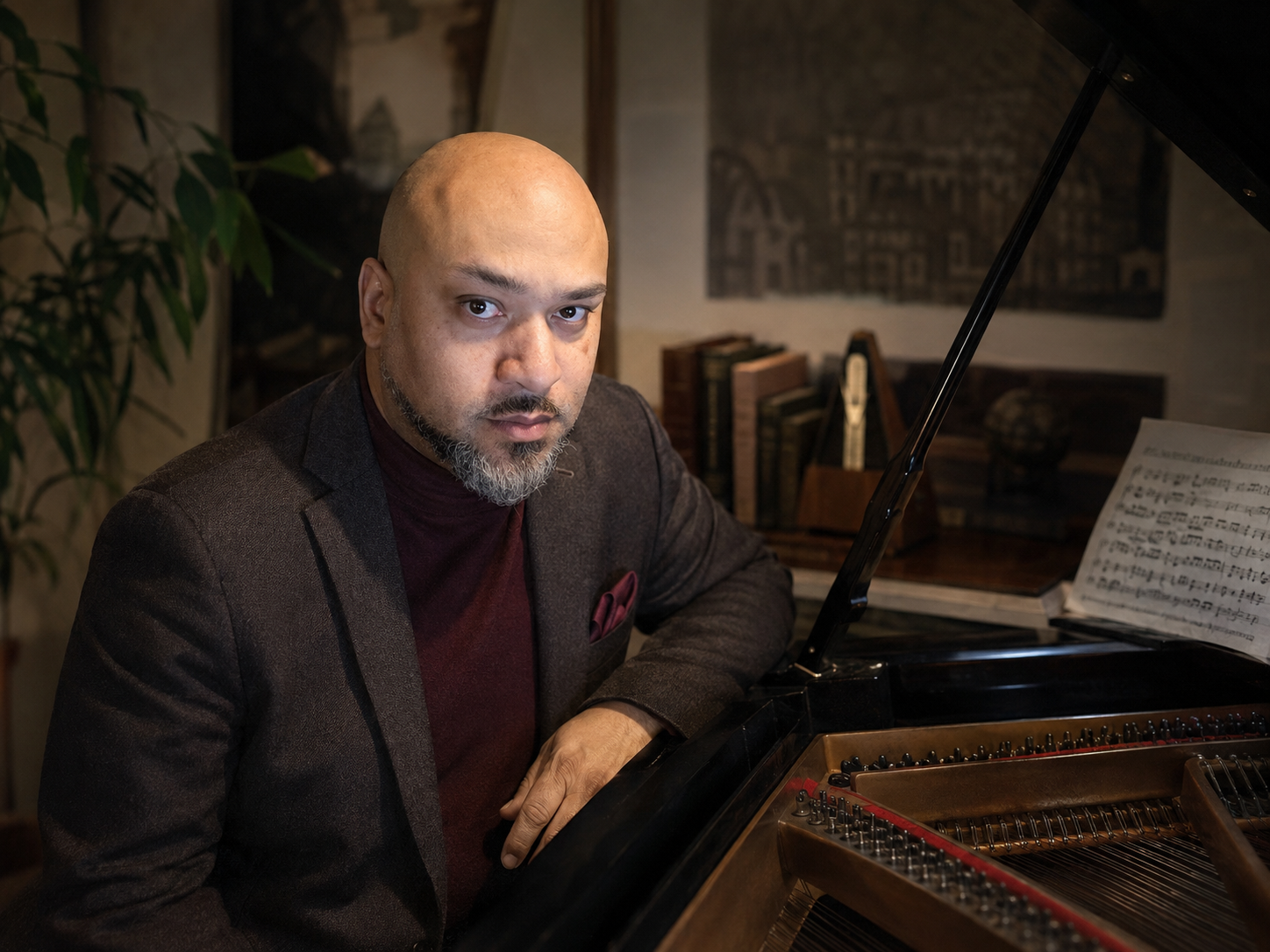
Meet Steven F. McClain
Musician. Educator. Coach.
Music has been part of Steven McClain's life for decades—as a performer, educator, conductor, director, writer, and lifelong student of the craft.
But the work that eventually became SFM Coaching began with something much simpler:
one musician sitting across from another.
For Steven, teaching has never been merely the transfer of information. It is an act of discovery—learning who a musician is, understanding what is standing between that musician and the next stage of growth, and finding the tools that can help move them forward.
That belief has shaped a career spent not only teaching musicians how to perform, but helping them understand how they learn, how they practice, how they listen, and how they develop a musical voice of their own.
Today, that work is SFM Coaching.
Music Was Never Just One Thing.
Long before there was SFM Coaching, there was the musician. Steven's musical life has never fit neatly inside a single instrument, ensemble, genre, or role.
Instrumentalist. Singer. Performer. Conductor. Composer and arranger. Director. Teacher. Student.
Each role offered a different way of understanding music.
Playing demanded technique—the physical ability to turn an idea into sound. Acting and Singing made the relationship between body, breath, intention, and expression impossible to ignore. Conducting required hearing beyond a single part: understanding how individual voices function within a larger whole and communicating an artistic idea without producing the sound directly. Writing and arranging meant looking beneath the surface of the notes—into harmony, structure, color, tension, expectation, and possibility.
Directing expanded those questions beyond music. How do you communicate an idea to another artist without simply telling them what to do? How do you create an environment in which someone can discover something you could never have prescribed?
And teaching brought all of those questions together.
Over time, these experiences stopped existing as separate disciplines.
They began informing one another.
A lesson learned through singing could illuminate instrumental technique. An idea discovered while conducting could change the way a student was taught to listen. Understanding physics could clarify something the body was doing. Theatre could reveal something about musical interpretation. Writing could sharpen an understanding of phrase, structure, tension, and release.
And sometimes a student asking a question Steven could not immediately answer became the beginning of an entirely new investigation. That curiosity became fundamental to his work. Music is not an isolated collection of notes, techniques, and rules.
It is sound. Movement. Language. Mathematics. History. Physics. Psychology. Culture. Communication. And ultimately, it is human expression.
So understanding music sometimes requires looking beyond the instrument in your hands.
The more ways we learn to understand music, the more possibilities we discover for making it.
That interdisciplinary curiosity would eventually become one of the foundations of SFM Coaching.
B.A. Music Education
MFA in Film
MMEd in Music Education
25+ Years as an Educator
30+ Years as a Performer
Multi-Instrumentalist
Conductor • Director • Writer • Actor
Teaching Changed the Musician.
There is a difference between knowing how to do something and knowing how to help someone else discover how to do it. Teaching made that difference impossible to ignore.
A technique that worked beautifully for one student did nothing for another. An explanation that immediately made sense to one musician left another completely unmoved.
Some students needed to see. Some needed to hear. Some needed to move. Some needed to understand the theory before the technique made sense. Some needed to stop thinking quite so much and simply experience the sound. And occasionally, the thing Steven had been taught was the “right way” turned out not to be the right way for the musician sitting in front of him.
That changed everything.
The Student Became Part of the Lesson.
Teaching across different instruments made the questions even more interesting. A concept encountered with a singer might illuminate something happening with a brass player. A pianist's coordination problem could raise questions about movement and physical efficiency. A student's difficulty hearing an interval might reveal why a technical correction wasn't working. A conductor's understanding of the entire score could change how an individual musician understood the importance of a seemingly insignificant part. Again and again, the same realization emerged:
The problem you can see is not always the problem you need to solve.
So Steven became increasingly interested in the why beneath the what. Why is this musician struggling? Why does this technique work? Why doesn't it work here? What is the body actually doing? What is the musician hearing? What does the music require? What happens if we approach the problem from somewhere completely different? And perhaps the most important question:
What can this student teach me about how they need to be taught?
Sometimes the Teacher Has to Say, “I Don't Know.”
There were questions Steven could answer immediately. There were others he couldn't. Those became some of the most valuable ones. Because “I don't know” did not have to mean the end of the lesson. It could mean:
Let's find out. Study the score. Research the technique. Listen differently. Examine the anatomy. Consider the acoustics. Try another fingering. Change the physical approach. Look at the history. Ask another musician. Test an idea. See what happens. Then return with better questions.
Over time, curiosity became as important to Steven's teaching as expertise. Because expertise without curiosity can eventually become certainty; and certainty can make it difficult to see the musician who is actually in front of you.
Teaching Became Collaboration.
As the years passed, Steven's role in lessons began to change. There were still things to teach. Standards to maintain. Techniques to develop. Musical traditions worth understanding. Challenges that required discipline and persistence. But the lesson did not have to be a place where one person possessed all the answers and the other simply received them.It could become a place of investigation.
What did you hear? What did you notice? What changed? Why do you think that worked? What would you try next?
Those questions did more than solve the problem in front of the student. They began teaching musicians how to solve the next problem themselves. And gradually, a philosophy began to emerge.
From Experience to Approach.
It wasn't created all at once. There was no single lesson when Steven sat down and decided to invent a teaching methodology. It accumulated student by student; question by question. Mistake by mistake. Experiment by experiment. Year after year. Eventually, the ideas that had been developing through decades of teaching could be expressed simply:
UNDERSTAND. DEVELOP. OWN.
Understand the musician, the music, the challenge, and the process. Develop the technique, musicianship, and artistry necessary to move forward. Own the knowledge, choices, problem-solving, and musical voice that emerge. Today, those ideas form the foundation of The SFM Approach. But they began somewhere much less formal:
in the lesson room, with musicians who kept teaching their teacher how much there was still to learn.
THE WORK CONTINUES
One Musician at a Time.
The instruments change.
The goals change.
The challenges change.
But the work remains remarkably simple:
Meet the musician where they are.
Understand what they need.
Help them discover where they can go next.
Whether you're beginning, returning, preparing for something specific, or simply wondering what the next stage of your musicianship might look like, the conversation can begin with one question: