The SFM Approach
The Musician Comes First.

Every musician is different.
We bring different bodies to our instruments. Different experiences. Different ways of hearing, thinking, processing, and understanding. We have different ambitions, different challenges, and different reasons for making music in the first place.
So why should every musician be taught exactly the same way?
At SFM Coaching, instruction begins not with the instrument, the method book, or even the music.
It begins with the musician.
Movement I.
EDUCERE
To Draw Out.
The word education traces its roots, in part, to the Latin educere: to lead out, to bring forth, to draw out.
That idea sits at the heart of the SFM Approach.
We do not believe that a teacher's job is simply to pour information into a student. Nor do we believe that becoming a musician means learning to imitate the teacher.
The musician is already there.
Curiosity is there.
Imagination is there.
Instinct is there.
Potential is there.
What is keeping this musician from moving forward?
That question changes the relationship between teacher and student.
The teacher becomes more than an instructor.
The teacher becomes an observer. A diagnostician. A guide. A collaborator. A coach.
And the student becomes more than a recipient of information.
The student becomes an active participant in their own development.
The Instrument Is Not the Musician.
An instrument is a means of expression.
Technique gives us greater control over that means of expression—but technique alone does not create musicianship.
This is why SFM Coaching does not begin by asking only:
“What should you be able to play?”
Our work is to draw it out. That means teaching cannot begin with the assumption that every musician needs the same solution. A technical problem may require a physical solution.
A rhythmic problem may actually be a listening problem.
A performance problem may be rooted in preparation rather than ability.
A student struggling with a passage may not need to practice it more. They may need to understand it differently.
And sometimes the most important thing a teacher can do is stop providing answers long enough to ask the right question.

We also ask:
What do you hear?
What do you understand?
What are you trying to communicate?
What is preventing you from doing it?
How do you learn most effectively?
And perhaps most importantly:
What kind of musician are you becoming?
Once we understand the musician in front of us, we can begin developing the tools that musician needs.
That leads to the first principle of the SFM Approach:
UNDERSTAND
Before we decide how to move forward, we learn to understand where you are.
Movement II
UNDERSTAND
Start With the Musician.
Experiment With Purpose.
Music lessons should be places where musicians are allowed to investigate.
Change the breath. Change the fingering. Change the articulation. Change the tempo. Change the physical movement. Change the practice strategy. Sing the phrase. Clap the rhythm. Play it backward. Remove the instrument. Put the instrument back.Try something that might not work. Then listen.
What changed?
Experimentation is not guessing. It is the deliberate process of changing a variable, observing the result, and using what we learn to make a better decision. That process develops something far more valuable than the ability to perform one passage correctly.
It develops musical problem-solving.
Mistakes Are Data.
A mistake also gives us information. It may tell us what we don't yet understand. It may reveal a technical limitation. It may expose a habit. It may show us where concentration disappeared. It may even reveal that the strategy we're using simply isn't effective.
So the goal is not to create musicians who are afraid of mistakes. The goal is to create musicians who know what to do with them.
When musicians learn to observe themselves without immediately judging themselves, something changes.
Instead of:
“I can't do this.”
the question becomes:
“Why didn't that work?”
And then:
“What can I change?”
That shift—from judgment to curiosity—is one of the foundations of independent musicianship.
Before we correct, we observe.
Before we prescribe, we listen.
Before we decide what comes next, we ask a simple question:
What is actually happening?
Two musicians can struggle with exactly the same passage for completely different reasons. One may not understand the rhythm. Another may understand it perfectly but lack the technical coordination to execute it. One may need greater breath support. Another may be using too much. One may need repetition. Another may have repeated the same mistake so many times that repetition is now reinforcing the problem.
One musician may need an explanation. Another needs to hear it. Another needs to see it. Another needs to feel it. And sometimes a musician simply needs permission to experiment long enough to discover what works. That is why individualized coaching means more than changing the difficulty of an assignment.
It means understanding the MUSICIAN who is doing the learning.
Diagnose Before You Prescribe.
When something isn't working, the obvious problem isn't always the actual problem.
A missed note may begin several measures earlier.
An articulation problem may actually be an air problem.
An intonation problem may be connected to hearing rather than technique.
A difficult piano passage may not be a finger problem at all—it may be a coordination problem.
A singer struggling with a phrase may not need more volume. They may need greater freedom.
A musician who appears unprepared may not lack discipline. They may never have been taught how to practice.
So rather than immediately saying:
“Do it again.”
we begin asking:
What changed? What did you hear? What did you feel? Where did the problem begin? What happens if we change one variable? Can you explain what you are trying to do?
These questions turn mistakes into information. And information gives us somewhere to go.
Learn How You Learn.
Every musician eventually encounters something a teacher cannot solve for them.
A new piece. A difficult passage. An unfamiliar style. A technical challenge. A performance problem. A musical decision for which there is no single correct answer. At that moment, the most valuable thing a musician can possess is
self-knowledge.
What helps you understand something new? What happens when you become frustrated? How do you recognize tension? What practice strategies work for you? How do you know when repetition is helping… and when it is merely repeating? What do you hear when you listen to yourself? What do you do when something doesn't work? These questionsare part of becoming advanced musicians. .
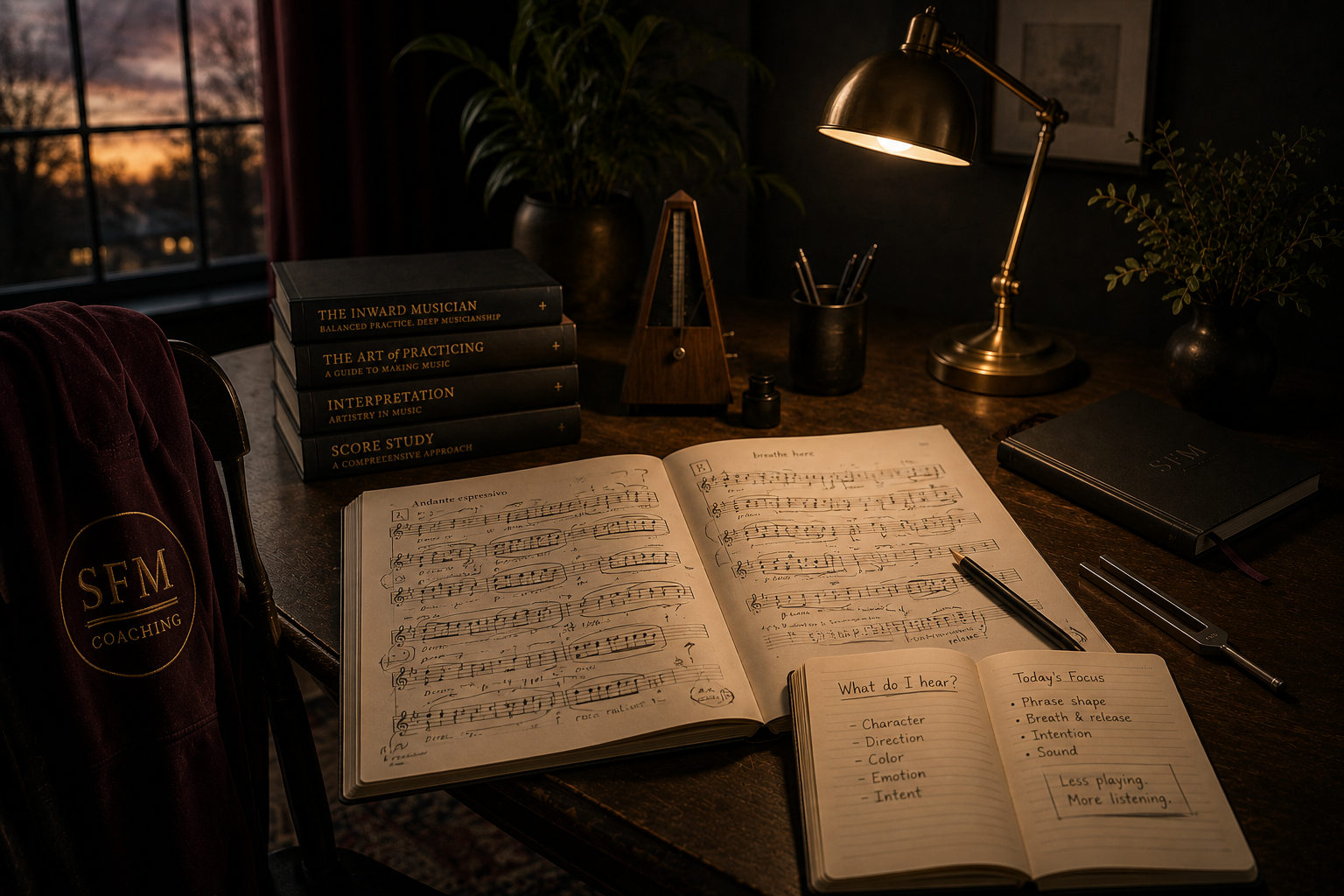
Understanding Creates Direction.
Once we understand what is happening, we can stop throwing solutions at the problem. We can choose. Choose the exercise. Choose the practice strategy. Choose the technical adjustment. Choose the musical concept that needs attention. Choose when to slow down. Choose when to move forward. Choose when to stop practicing the passage and start studying the music.
That is the purpose of the first principle of the SFM Approach.
UNDERSTAND
Understand the music. Understand the problem. Understand the process. Understand yourself. Because once we understand where we are and what is standing in the way, we can begin deliberately building what comes next.
And that brings us to the second principle:
Movement III
DEVELOP
Build the whole musician
Technique. Musicianship. Artistry. Not in isolation—but together.
Development asks:
Where do we go from here?
At SFM Coaching, development is not measured simply by how many scales a musician can play, how high they can sing, how quickly they can move through a passage, or how many pieces they have completed. Those things can matter. But they are evidence of development—not its definition.
Our goal is to develop musicians who possess the physical tools to express themselves, the musical understanding to make informed decisions, and the artistic imagination to have something worth expressing.
That means developing three things together:
TECHNIQUE • MUSICIANSHIP • ARTISTRY
Each strengthens the others. And none is complete without the other two.
TECHNIQUE
Give the Musician the Tools to Communicate.
Technique is freedom. The purpose of technique is not merely to perform something difficult. It is to reduce the distance between what the musician imagines and what the audience hears.
Breath. Embouchure. Fingering. Articulation. Coordination. Posture. Tone production. Range. Flexibility. Dexterity. Rhythmic precision. Physical efficiency.
These are just tools.
A musician may hear a beautiful phrase internally, but without sufficient technical command, that idea may never reach the listener.
So we develop the body. We develop coordination. We develop consistency. We develop control. But we also ask an important question:
Control for what purpose?
The goal is to give the musician enough command of their craft that technique stops standing between intention and expression.
When the musician thinks:
I want the phrase to do this...
the body increasingly knows how to respond.
MUSICIANSHIP
Understand the Language Behind the Notes.
Playing the correct notes is not the same as understanding the music. Musicianship gives context to what technique makes possible.
Rhythm. Melody. Harmony. Form. Theory. Ear training. Style. History. Notation. Analysis. Listening. Ensemble awareness. Score study.
These allow musicians to move beyond:
“What note comes next?”
toward:
“Why is this note here?”
Why does this harmony create tension? Where is this phrase going? What role does my part serve? What happened earlier that makes this moment significant? What is the composer asking us to notice? What does this style require? What changes when I hear my part as one voice within something larger?
Understanding changes performance.
A scale is no longer simply an exercise when the musician begins recognizing it inside repertoire. An arpeggio is no longer merely a technical pattern when the musician hears the harmony it outlines. A rhythm is no longer something to count mechanically when the musician understands its relationship to pulse, gesture, style, and movement.
Theory stops being something learned about music.
It becomes something musicians use inside music.
ARTISTRY
Have Something to Say.
Technique gives us the ability. Musicianship gives us understanding. Artistry asks:
What are you going to do with them?
Music is more than accurate reproduction. A score gives us extraordinary information, but it cannot make every artistic decision for us.
How does the phrase breathe? Where does it lean? Where does it release? What deserves attention? What should remain understated? What emotional world does this music inhabit? What does silence mean here? What does this moment require from you? Artistry develops when musicians learn that interpretation is not decoration added after the notes have been learned.
Interpretation is part of learning the music.
This means developing imagination. Curiosity. Taste. Intent. Courage. Sensitivity. Communication. And eventually, voice.
Two musicians can perform the same notes, rhythms, articulations, and dynamics accurately—and communicate completely different experiences.
Sometimes, that difference is artistry.
The Three Must Speak to One Another.
Technique without musicianship can produce execution without understanding. Musicianship without technique can produce ideas the musician cannot yet communicate. Technique and musicianship without artistry can produce correctness without expression. But when the three develop together, something different becomes possible. The musician begins connecting:
What do I want to communicate?
with
What do I understand about the music?
with
What must I be able to do to make that idea audible?
TECHNIQUE+ MUSICIANSHIP+ ARTISTRY
Intention becomes expression.
Development Is Not Linear.
Musicians do not develop in straight lines. There are breakthroughs…
Plateaus…
Frustrations…
Reclamations…
Growth…
Periods when technique moves rapidly while artistry seems to stand still. Moments when greater musical understanding suddenly exposes technical limitations that weren't noticeable before. Times when a musician appears to step backward because they are rebuilding something more intelligently. And sometimes progress becomes visible only after weeks or months of work that seemed to produce very little.
This is why SFM Coaching does not measure every musician against the same timeline. The relevant question is not:
“Where should you be by now?”
It is:
“What does your next stage of development require?”
That answer changes. So the work changes with it.
Growth Requires Challenge.
Movement IV
OWN
Discover the musician within you!
The goal is not simply to become a better student.
There comes a moment in a musician's development when the question changes. At first, we ask:
“What should I do?”
Then:
“How should I do it?”
Eventually, something more important emerges:
“What do I think?”
The Goal Is Independence.
A teacher can demonstrate. Explain. Correct. Challenge. Encourage. Question. Suggest. A teacher can introduce a musician to ideas they might never have encountered alone. But there is one thing a teacher should never try to do:
Become indispensable.
At SFM Coaching, the goal is not to create musicians who need someone standing beside them forever telling them what to do next. The goal is to develop musicians who increasingly know how to determine that for themselves. A musician should eventually be able to encounter a problem and ask:
What am I hearing? What isn't working? Why might it be happening? What strategies could I try? What changed when I tried them? What does the music require? What choice do I want to make?
The teacher's voice does not disappear. Over time, something better happens.
The musician develops one of their own.
Learn to Coach Yourself.
Practice is what happens when the teacher isn't there. That makes independent practice one of the clearest tests of musical ownership. Anyone can follow instructions during a lesson. But what happens tomorrow? What happens when the musician opens the case, sits at the piano, stands in front of the music stand, or begins warming up alone? Do they simply repeat what happened during the lesson?
Or can they observe? Listen? Diagnose? Experiment? Adjust? Evaluate? That is why SFM Coaching does not only teach musicians what to practice. We teach musicians how to practice.
The goal is to gradually internalize the process:
LISTEN → IDENTIFY → EXPERIMENT → EVALUATE → ADJUST
Hear what happened. Identify what needs attention. Choose a strategy. Observe the result. Decide what comes next. Then repeat the process—not mindlessly, but intentionally. Practice becomes less about accumulating repetitions and more about making increasingly intelligent decisions.
Movement V
MUSICIANSHIP
Your musicianship is yours!
There is no one else who can become the musician you are becoming.
Your Path Does Not Have to Look Like Anyone Else's.
You bring something to music that no method book, teacher, curriculum, or institution can provide: Your experiences. Your curiosity. Your imagination. Your body. Your ear. Your questions. Your challenges. Your taste. Your history. Your voice.
These things do not stand outside your musical development. They are part of it. The goal is not to erase those differences until every musician sounds, thinks, practices, and performs the same way. The goal is to develop the knowledge, technique, awareness, and freedom necessary to discover what you can do with them.
Every musician enters music differently. Some begin as children. Some discover music later. Some never stop playing. Some return after years away. Some dream of concert halls, studios, classrooms, stages, ensembles, or careers in music. Others simply want music to remain part of their lives.
There is no single destination that makes someone a musician. And there is no single path for becoming one. What matters is that the musicianship you develop becomes increasingly, unmistakably yours.
The Approach Is a Cycle.
The SFM Approach is not a staircase that musicians climb once. It is a process they can return to throughout their musical lives.
UNDERSTAND
Listen. Observe. Ask questions. Discover what is actually happening.
DEVELOP
Build the technique. Deepen the musicianship. Explore the artistry. Develop what the next stage requires.
OWN
Make decisions. Solve problems. Take responsibility. Trust what you have learned. Then something new appears. A new piece. A new challenge. A new instrument. A new ensemble. A new musical question. And we begin again.
Understand. Develop. Own.
Each time with greater experience. Greater awareness. Greater possibility.
The teacher can provide the tools. The coach can help illuminate the path. But ultimately:
The technique is yours. The understanding is yours. The artistry is yours. The voice is yours.
And the musician?